Pages

Monday, May 21, 2012

Hospice and Palliative Care Veteran Services (Research, Video 4:46)


Nat was my most memorable patient with military service. Keeping a small American flag taped to his bed was his way of honoring those who returned from service in body bags or with physical and mental injuries. Although he had fought in Viet Nam years before we met as hospice volunteer and patient, his stories about his war experiences were as raw and real as any I have heard. He shared these reflections with me one day:

“I’ve seen and done things you couldn’t imagine. Some of them were horrible, I mean really horrible. Don’t ask me to tell you what they were, because I can’t talk about it. They say time heals all wounds, but it’s a lie. I left Viet Nam, but Viet Nam never left me. I carry it with me everywhere I go. All these years later, I still have nightmares like you wouldn’t believe. The doctor says it’s post-traumatic stress disorder or PTSD. I wake up shaking, gasping for breath with tears in my eyes. In my dreams, I’m always running hard, trying to escape. Sometimes my enemies are close enough for me to touch. I almost stop breathing to keep them from hearing me. I’m constantly thinking I’m not going to make it. Some nights they kill me before I wake up.” (Excerpt from Becoming Dead Right: A Hospice Volunteer in Urban Nursing Homes)

The number of veterans receiving hospice care continues to become a major area of expansion for the Veterans Health Administration. Research by the Department of Aging and Mental Health Disparities at the University of South Florida indicates that, of the millions of dollars being spent on veterans in hospice care, most of the funds are spent on younger veterans. Future trends indicate a growing need to allocate more funds for end-of-life care. Support and appreciation for the horrific sacrifices veterans have made are especially important during their death journeys.

This video titled Reaching Out to Those Who Served was produced by the Tennessee Hospice Association as part of a grant through the Veterans Administration and the National Hospice and Palliative Care Organization. It presents a detailed overview of hospice and palliative care services for veterans.


Frances Shani Parker, Author
Becoming Dead Right: A Hospice Volunteer in Urban Nursing Homes is available in paperback at many booksellers and in e-book form at Amazon and Barnes and Noble booksellers.

Tuesday, May 15, 2012

Hospice Diversity Outreach: Share Best Practices (Video .32)

Quality end-of-life care is an entitlement for everyone. That is the hospice philosophy. Unfortunately, hospice services continue to be underutilized nationally among various racial-ethnic groups and cultures. While several barriers to utilization have been studied, solutions always include the necessity of more diversity outreach by hospice organizations.

Hospice organizations must take proactive outreach roles in presenting the benefits hospice provides, while making all recipients of their services feel welcomed and respected. These are a few examples of outreach best practices:

1.  Having a committee to identify, educate, and serve populations not
     being served
2.  Changing photos on brochures and other media materials to reflect diverse populations
3.  Making cultural diversity an important part of staff development and
     recruitment
4.  Having 24/7 language interpretation services provided and included in media outreach
5.  Participating in racial-ethnic and cultural health initiatives, festivals, and events

I recently visited the Arab American National Museum in Dearborn, Michigan. As soon as the guide approached me, I said, “As-Salāmu`Alaykum,” probably with a Southern drawl. This is an Arabic greeting often translated as “Peace be with you.” It’s used among Muslims around the world. The guide immediately smiled widely, not because my Arabic language skills are good, but I think because he appreciated that I had made an effort to respect his culture. It may seem like a small thing, but my personal language “outreach” brought a new energy and acceptance to our meeting. That’s what diversity outreach can do.

In the video below titled Avow Hospice Speaks the Language of Care & Compassion, Avow Hospice sends a similar kind of message to their website viewers by addressing them in Spanish, French, Creole, and English, demonstrating that “care, compassion, and respect for family traditions and culture have no language boundaries.” Their website, which, translates into other languages, reaches out.

Sharing successful diversity outreach best practices can be a great strategy for hospices in promoting diversity in larger numbers.  Surely, there are hospice organizations that have created positive diversity outreach practices that can benefit others.  By sharing what your organization is doing, you send messages to other hospice organizations, potential staff members, patients, and community members that you support the hospice philosophy of quality end-of-life care for everyone.


Frances Shani Parker, Author
Becoming Dead Right: A Hospice Volunteer in Urban Nursing Homes is available in paperback and e-book editions in America and other countries at online and offline booksellers.

Monday, May 7, 2012

Mother's Day Tribute to Mother Who Died From Alzheimer’s Disease (Video 5:07)


This post is dedicated to mothers everywhere, especially those who are living with or who have died from a terminal illness. The accompanying video is by raindancer808 from New Orleans, Louisiana. She honored her mother before she died with this Mother’s Day tribute that her mother never saw. She wrote:
“My Mom is in end stage Alzheimer's, and I wanted to do something special for her on Mother's Day.”


You can also read my tribute to a nun who positively impacted my life as a child and later developed and died from Alzheimer’s disease here:


Frances Shani Parker, Author
Becoming Dead Right: A Hospice Volunteer in Urban Nursing Homes is available in paperback at many booksellers and in e-book form at Amazon and Barnes and Noble booksellers.

Monday, April 30, 2012

Asexual Older Adults (Research, Asexuality Video 8:01)


Clara Meadmore, an asexual older adult, was Britain’s oldest virgin at 105 years old. According to an article by Luke Salkeld in Mail OnlineClara credited not having sex as the secret of her longevity. Proud of her innate celibacy, she said she just wasn’t interested in all the “hassle” of having sex. Ironically, while many people wrongly stereotype older adults as being asexual simply because they are old, people like Clara intrinsically have never had any interest in sex or sexual attraction to others.

I became interested in learning more about asexuality in older adults after attending an informative Area Agency on Aging workshop about healthcare and other life issues of lesbian, gay, bisexual, and transgender (LGBT) older adults. As we discussed misunderstanding and intolerance regarding sexual orientation, one participant reminded us that asexuality is frequently excluded in these conversations. Later while researching this topic on my own, I discovered that asexuality, particularly regarding older adults, has only become scientifically researched as a sexual orientation in recent years.

Like many in the LGBT population, asexuals  have unique issues adjusting to a predominantly heterosexual and sex-oriented society. Some have the need to “come out of the closet” and explain their identity in order for others to understand them better. Others may feel ashamed, isolated, or confused because they are different from the standard society conveys as normal sexuality. They are a diverse community with people experiencing relationships in various ways. For example, some may have close relationships with sexual or asexual partners, although the asexual partners have no sexual attraction. Emotional and romantic attractions are not the same as sexual attraction.

I noticed that the media focus on asexuals emphasizes younger adults. In one asexual group forum I visited on the Internet, an older adult woman asked several times for help in finding other older asexual adults with whom she could communicate. Asexual older adults have more difficulty finding resources and supportive groups where they can share their concerns in an accepting environment. Fortunately, the Asexual Visibility and Education Network (AVEN) hosts the world's largest online asexual community and a large archive of resources on asexuality that can benefit anyone interested in this topic. The Asexual News is another helpful resource. You can read a more recent blog post of mine on asexuality here.

The following video titled Asexuality: The Making Of A Movement Trailer focuses on the emergence of the asexual community and the lives of several asexual people. The completed full-length film documentary directed by Angela Tucker premiered at the Frameline Film Festival in San Francisco's Roxie Theatre on June 18, 2011.


Frances Shani Parker, Author
Becoming Dead Right: A Hospice Volunteer in Urban Nursing Homes is available in paperback and e-book editions in America and other countries at online and offline booksellers.

Monday, April 23, 2012

Rural vs. Urban End-of-Life Care (Nursing Home Research, Video 1:37)


Dying is universal, but what about differences and similarities in end-of-life (EOL) care? Most of my nursing home experiences with hospice care have been in an urban area. I was curious about this University of Rochester, NY research that compared rural and urban end-of-life care in nursing homes.

The purpose of this study by the University of Rochester, NY was to examine urban-rural differences in end-of-life quality of care provided to nursing home residents. A national sample of nursing homes was used. Three measured areas of focus were in-hospital death, hospice referral before death, and presence of severe pain.

Research results indicated there were urban-rural differences for in-hospital death and hospice quality measures, but not for pain. Compared with nursing homes located in urban areas, facilities in smaller towns and in isolated rural areas had significantly worse EOL quality for in-hospital death and hospice use. Differences were not statistically significant between facilities located in small towns and isolated rural areas.

According to the report, this study provides “empirical evidence for urban-rural differences in EOL quality of care using a national sample of nursing homes.” This research data is important because it serves as a necessary first step toward improving EOL care for dying nursing home residents and for bridging the urban-rural gap.

This video titled End of Life: Burdensome Transitions from Brown University refers to another EOL study that addresses health care transitions such as moves from the nursing home to the hospital. These burdensome transitions can result in medical errors and lack of care coordination. For persons with advanced dementia, they can cause emotional distress and agitation. According to this study, such transitions are not consistent with goals of providing dying patients with comfort, and a fifth of them experience at least one during their last three months. African Americans and Hispanics were more likely than whites to experience these burdensome transitions.


Frances Shani Parker, Author
Becoming Dead Right: A Hospice Volunteer in Urban Nursing Homes is available in paperback at many booksellers and in e-book form at Amazon and Barnes and Noble booksellers.

Monday, April 16, 2012

Parkinson’s Disease: Children’s Views (Video 5:19)


Parkinson’s disease, a degenerative nervous system disorder, is common among older adults. Symptoms can include impaired shaking (tremors), walking, movement, and coordination. As with any disease, children are impacted by family members who have it. Having been an educator of students from ages three through eighteen for many years, I know that a quick way for them to believe incorrect information about important topics is to have adults not give them accurate age-appropriate answers to questions they may or may not ask. John Provo, a grandfather with Parkinson’s disease, is a man who addresses this concern.

He meets children’s informational needs about Parkinson’s disease by finding out what they want to know, helping them understand and cope with the disease, and by giving them concrete ways to help someone who has it. He invited children from all over the world to write to him about their experiences with parents and grandparents with the disease. He has created several videos specifically with children in mind. These are questions children often have about Parkinson’s disease:

What is Parkinson’s disease?

What causes it?

Is there a cure?

Is Parkinson’s disease hereditary or contagious?

What changes will occur with someone who has the disease?

Can someone die from Parkinson’s disease?


In this video Through the Eyes of a Child -Part 5.wmv, John Provo’s granddaughters speak about their Parkinson’s disease experience with him.

"Life is not always easy for you, or the people you love.  Be brave, be kind, be understanding".
                                          - John E. Provo


Frances Shani Parker, Author
Becoming Dead Right: A Hospice Volunteer in Urban Nursing Homes is available in paperback at many booksellers and in e-book form at Amazon and Barnes and Noble booksellers.

Wednesday, April 11, 2012

Chaplains Provide Spiritual Health (Hospice-Palliative Research, Music Video 2:12)


We often hear about end-of life care with emphasis on the roles of doctors and nurses. Spirituality of patients may be overshadowed sometimes by the more visible efforts of providing quality of life at physical levels. But hospice-palliative care chaplains also make positive differences in the healthcare status of many patients by providing a comforting presence during a critical phase in life.

Duke University research documenting the relationships between the receipt of less spiritual care than desired and patient outcomes was done with 150 patients with advanced cancer.  The vast majority of them (91%) indicated they had spiritual needs. Most desired and received spiritual care from their healthcare providers, religious community, and hospital chaplain. Unfortunately, a significant subset of patients didn’t receive the level of spiritual care they wanted. When this happened, patients were at risk of depression and reduced sense of spiritual meaning and peace. These unmet spiritual needs negatively impacted patients’ healthcare status.
A’Shellarian Anthony, chaplain at Delaware Hospice, provides weekly counsel and prayer with her patients. Part of a unique program there that includes specialists who sing, she also provides the healing powers of music:


Frances Shani Parker, Author
Becoming Dead Right: A Hospice Volunteer in Urban Nursing Homes is available in paperback at many booksellers and in e-book form at Amazon and Barnes and Noble booksellers.

Wednesday, April 4, 2012

Drive-Through Funerals, Bacon Coffins, Modern Death Rituals (Video 2:41)

Through the years, funeral rituals have grown to new heights with awe-inspiring audio and visual displays including themes that would make the deceased proud. With the existence of drive-through cemeteries with low, tilted monuments that glow in the dark for easy reading at night, it’s no surprise that drive-through funerals where you can “have it your way” followed.

Drive-through funeral homes with bulletproof glass provide the opportunity for mourners and the curious to drive or walk up from the street, view the deceased resting in peace, and sign the guestbook. When the deceased is displayed just right, a high compliment might be expressed such as “Look how she’s dressed. Bless her soul. That looks just like her.”

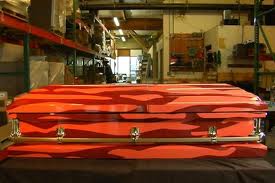
Funerals have evolved in many ways including having the deceased posed in action positions such as riding a motorcycle. Some golf lovers are being funeralized with decorations, services, and food centered around a golf theme. Coffins created to look like bacon (with bacon-scented air fresheners), animals, plants, and vehicles are only a few innovations reflecting creativtiy beyond the traditional.

Bacon lovers can experience the satisfaction of bacon-decorated coffins with bacon-scented air fresheners.

Some say that all these modern death ritual innovations trivialize death and take away from the spirituality of the service. Others say they customize people's feelings while including the spirit of those who have been unfastened from this life. One thing most people agree on is that relatives and friends who die will keep on being mourned and celebrated. This video shows mourners paying respects at a drive-through funeral.


Frances Shani Parker, Author
Becoming Dead Right: A Hospice Volunteer in Urban Nursing Homes is available in paperback at many booksellers and in e-book form at Amazon and Barnes and Noble booksellers.
Hospice and Nursing Homes Blog

Monday, April 2, 2012

Hospice + Dementia: Are Bereaved Families Satisfied? (Research, Alzheimer’s Video Poem 2:24)


Through the years, I have had many occasions to work with families of hospice patients who had dementia. For many relatives, experiencing a loved one’s mental decline is extremely difficult. Hospice workers can offer greatly needed support to families adjusting to these changes and in maintaining quality of life for patients.

When the death journey is over, how do bereaved families rate the hospice services their deceased loved ones who died from dementia received? Hospice-related dementia research examining the effectives of hospice services was done with 260 of 538 bereaved family member respondents from five states. The following hospice ratings from bereaved families were reported:

1) Fewer unmet needs and concerns with quality of care

2) Higher rating of the quality of care

3)    Better quality of dying than those without hospice services
This research from the perspectives of bereaved family members affirms satisfaction with hospice services for patients with dementia.
My own personal interactions as a hospice volunteer serving nursing home residents with dementia were quite inspiring. I can truthfully say that our time together was mutually beneficial. One thing I know for sure is that I became a better person. Titled Pieces of Our Minds, this original video poem conveys my thoughts about what it is like inside the minds of people with dementia.


Frances Shani Parker, Author
Becoming Dead Right: A Hospice Volunteer in Urban Nursing Homes is available in paperback at many booksellers and in e-book form at Amazon and Barnes and Noble booksellers.