Pages

Showing posts with label Research. Show all posts

Wednesday, November 2, 2022

Dying: Being in Control (Research, Hospice Story)


Are you ready to die? Because I have been a hospice volunteer many years, people sometimes assume that my patients and I talk about death a lot. We don't. But death-related discussions are important parts of advanced care planning and palliative care. S
ome people also assume my volunteer visits must be depressing because no one really wants to die. Wrong again. Some of my patients have stated they looked forward to death and gave reasons that had nothing to do with depression.

People have complex attitudes about death, dying, and ethical considerations. A Massive Open Online Course (MOOC) titled “Dying2Learn” provided an opportunity for researchers to explore societal and personal attitudes about wishes and beliefs regarding death and dying. Among research results highlighted were desires of patients to exercise choice and control in relation to dying. Some individuals wanted control while preferring not to know that they were dying. Others wanted to know as much as possible and still be more in control. Even after legal matters related to death were in order, some patients had concerns that others might not consider important, but the element of control still mattered.


All this talk about control reminds me of my hospice patient named Rose. Are you ready to die? Rose was. This is what she said to me about her upcoming death that clearly indicated her need for control:

She began by asking me, “How old did you tell me I was?”

I responded, “You’re ninety-nine, and you’ll be a hundred years old on your next birthday.”

“A hundred years old is too old. I don’t think I want to be that old.”

“There are three other ladies in this nursing home who are older than that. One is a hundred three. We talked to her last week during your wheelchair ride.”

“How much longer will it be before I make a hundred? I don’t know if I want to wait too much longer.”

“It’s only one more month. I remember you said you had spiritual talks with your minister. If you decide to wait, I’ll get you a big balloon that looks like a birthday cake.”

“I guess I could wait. Yes, I think I will wait. That way I can celebrate my hundredth birthday. When I do get to heaven, I can tell everybody I lived to be one hundred.”

And that’s exactly what she did because she felt she was in control.

(Excerpt from Becoming Dead Right: A Hospice Volunteer in Urban Nursing Homes)

Frances Shani Parker, Author
Becoming Dead Right: A Hospice Volunteer in Urban Nursing Homes is available in paperback and e-book editions in America and other countries at online and offline booksellers. 
Visit Hospice and Nursing Homes Blog and Frances Shani Parker's Website.

Wednesday, November 30, 2011

Are You Satisfied With Your Hospice Job? (Research, Video 1: 22)

              Pictured are members of the Guardian Hospice Care Team in Alexandria, LA.
           
Are you satisfied with your hospice job? If a poll were taken today, do you think most of your fellow employees would share your feelings? How people feel about their jobs can impact their lives greatly. Taking time to evaluate job satisfaction can be informative, particularly for improving quality of life.

Hospice workers face unique challenges as they interact regularly with terminally ill patients and their families. How do workers in the various hospice disciplines rate their job satisfaction? Researchers at the Center for Bioethics at the University of Pennsylvania School of Medicine evaluated 8,495 staff members from 177 participating hospices in 41 states. They used the Survey of Team Attitudes and Relationships (STAR) with these results:

The mean score was 28 on a 0-100 scale. Hospice-level scores ranged from 15 to 44 with 44 being the highest level of satisfaction. The following are categories and scores:

Physicians -- 42
Chaplains -- 30
Nurses' Aides – 29
Nonclinical staff and clinical staff -- 28
Bereavement Coordinators -- 27
Nurses -- 26
Social Workers -- 25
This research concluded that variations in job satisfaction among hospices and disciplines are significant. Do these results surprise you, or did you expect them to be similar?


In this video, Dr. Martha Twaddle, Chief Medical Officer of Midwest Palliative & Hospice CareCenter, explains the role of the hospice interdisciplinary team. 


Frances Shani Parker, Author
Becoming Dead Right: A Hospice Volunteer in Urban Nursing Homes is available in paperback and e-book editions in America and other countries at online and offline booksellers.


Friday, October 7, 2011

Hispanic, Mexican American Male Caregivers (Research, Alzheimer’s Video 2:48)


According to the National Alliance for Caregiving, in collaboration with AARP, more than 65 million people, 29% of America’s population, are caregivers for the chronically ill, disabled, or aged family members or friends. A family caregiver is usually a woman. Typically, she is 49 years old and caring for her widowed 69-year-old mother who does not live with her. She is married and employed. More than 37% have children or grandchildren under 18 years old living with them.

With these statistics, it’s little wonder we seldom hear about male caregivers, but they are out there with stories that need to be told. This post focuses on Hispanic, Mexican American male caregivers, particularly those taking care of parents. In a federally-funded study of 110 Mexican Americans who were caregivers in lieu of a female relative, the following results were reported:

1)   Caregiving strain and burden in Mexican American males may have more to do with physical and emotional costs than financial ones.

2)   Mexican American males providing personal care for their mothers adopt a matter-of-fact approach as they act "against taboo."

3)   This caregiving approach is a new way to fulfill family obligations

Ric Gomez quit his job and became a caregiver for his father who has Alzheimer’s disease. In this video interview with KPBS reporter Amita Sharma, Ric shares the triumphs and challenges of his caregiving experience.


Frances Shani Parker, Author
Becoming Dead Right: A Hospice Volunteer in Urban Nursing Homes is available in paperback at many booksellers and in e-book form at Amazon and Barnes and Noble booksellers.

Thursday, September 15, 2011

Intergenerational Volunteering Relieves Dementia Stress (Research, Video 1:38)


I watched them playing together, both mesmerized by the rolling magic of a colorful ball slowly passing between them. One was two years old, and the other was eighty years old with dementia. I couldn’t help but smile. They had discovered the bridge that eludes many of the wisest and most educated.

The bridge is that universal connection between two people that makes them one in the moment. Too often, it is assumed that people with dementia, who may not even recognize their own children, are no longer capable of truly connecting as volunteers for others. Thoughts of having them improving their quality of life while performing intergenerational service can easily be dismissed. That’s when we have to be reminded about the bridge. The Department of Humanities at Penn State College of Medicine did just that when they set out to research whether an intergenerational volunteering intervention could enhance quality of life for persons with mild to moderate dementia.

This research involved fifteen participants forming intervention and control groups. Volunteering in hour-long sessions with kindergarteners and older elementary students, intervention group members participated in alternating weeks over a five-month period. Data were collected and analyzed regarding their cognitive functioning, stress, depression, sense of purpose, and sense of usefulness.

Results indicated significant decrease in stress and improved quality of life in three main areas: perceived health benefits, sense of purpose, sense of usefulness, and relationships. Results didn’t mention the bridge, but I know it was there. That’s what the bridge does when appropriate opportunities are created for it to transform lives.
In this video from the Alzheimer’s Society (UK), Lesley, who has dementia, has been fortunate in discovering many bridges that improve the quality of her life. She discusses her previous work with children, her current volunteering with learning disabled adults, and the “lucky” moments that inspire her to be herself.


Frances Shani Parker, Author
Becoming Dead Right: A Hospice Volunteer in Urban Nursing Homes is available in paperback at many booksellers and in e-book form at Amazon and Barnes and Noble booksellers.

Friday, September 2, 2011

Training Hospice-Palliative Volunteers for Cultural Competence (Research, Video 1:42)

Hospice-palliative volunteers and other healthcare workers can operate with a higher level of confidence and efficiency when they display cultural competence during their interactions with diverse patients. This competency is greatly needed to foster increased participation of ethnic groups that continue to underutilize hospice-palliative services.

A study in the Greater Toronto Area (GTA) examined the current state of culturally competent care. Using 14 hospice volunteers, researchers from the Department of Sociology at McMaster University did in-depth interviews with them to gain more understanding about their cultural competency status and challenges such as misunderstandings resulting in hurt feelings. Volunteers revealed the following in their responses to the questions:

1)   Volunteers with weak levels of cultural competence said they encountered cultural clashes with patients.

2)   Volunteers revealed that they needed more education in cultural competence as part of their hospice training.

3)   There was a lack of ethnic, cultural, and linguistic diversity among the hospice volunteers.

While this research was done with a small group, it serves as an example to hospice-palliative organizations and other healthcare institutions that cultural competence issues must be addressed. Ongoing staff education is a necessary component for the successful delivery of healthcare. In addition to improving patient-staff relations, eliminating cultural insensitivity and miscommunication will positively impact patients’ quality of life.

This video explores the importance of cultural competence training for workers in a cross-cultural healthcare environment. Examples of various cultural groups and how to interact with them are explained:


Frances Shani Parker, Author
Becoming Dead Right: A Hospice Volunteer in Urban Nursing Homes is available in paperback at many booksellers and in e-book form at Amazon and Barnes and Noble booksellers.

Thursday, August 11, 2011

Should Loved Ones Watch CPR (Cardiopulmonary Resuscitation)? (Research, Video 2:13)

Your loved one is in the throes of cardiac arrest. Tension engulfs the air as medical personnel proceed to perform CPR. Should you be allowed to watch? Do you even want to? Many will say you shouldn’t watch because of possible anguish and confusion involved. Some medical personnel may be concerned about liability and possible interference by you or family members witnessing this traumatic event.

But research supports having family members present. Witnessing CPR of a loved one helps observers understand the severity of the situation, appreciate the care being given, and even supports healthy grieving by confirming that everything was done.  With the development of appropriate policies and proper training of staff, the presence of family members during CPR can be a fulfilling experience.

This video shares positive views on this topic from Dr. Tammie Quest, Director of Education in Palliative and End-of-Life Care - Emergency Medicine Project, Associate Professor, Department of Emergency Medicine, Emory University School of Medicine:


Contact your local American Red Cross for CPR training.

Frances Shani Parker, Author
Becoming Dead Right: A Hospice Volunteer in Urban Nursing Homes is available in paperback at many booksellers and in e-book form at Amazon and Barnes and Noble booksellers.

Thursday, July 14, 2011

Nursebot Pearl, a Robotic Assistant for Older Adults (Video 5:21)


Meet Nursebot Pearl, a robot that will make you rethink your vision of how a caregiver can look and interact with you. Whenever I mention the use of robots for improving the quality of life of older adults, someone feels compelled to remind me that robots can’t replace people. I totally agree. But the reality is that people are living longer, and the population of older adults with ongoing health concerns continues to increase. Those living at home with chronic disorders are particularly in need of support that robotic technology can provide.

Several years ago, researchers from the University of Pittsburgh and Carnegie ‎Mellon University started the Personal Robotic Assistants for the Elderly project, an inter-‎disciplinary multi-university research initiative focused on robotic technology for the ‎elderly. The project goal is to develop mobile, personal-service robots that assist older adults suffering from chronic disorders in their everyday lives. Pearl continues to be researched and improved. The National Science Foundation funds her development.

A talking robot, Pearl’s face has interchangeable parts that display various emotions. Among many tasks, she can help seniors maintain their independence by reminding them about hygiene, medications, doctor’s visits, and other important information they might forget. She can send information remotely to caregivers and provide needed strength for manipulating objects. A major benefit for older adults living alone is the social interaction they can enjoy in her company.

Frances Shani Parker, Author

Friday, June 24, 2011

Hospice Racial-Ethnic Outreach: African American Brochures (Research, Video 1:47)

Hospice services are underutilized nationally among racial-ethnic communities. While several barriers to utilization have been studied, solutions always include the necessity of more outreach to racial-ethnic groups by hospice organizations.

The Leonard Davis School of Gerontology at the University of Southern California researched the outreach possibilities of comprising a brochure of hospice patient role model stories aimed at improving attitudes and knowledge of hospice among older African Americans. They used community-based organizations that included senior centers, community exercise programs, churches, and senior care management services in the greater Los Angeles area. Participants were seventy-one African Americans aged 65 and older.

Hospice brochures with role model stories showcased African Americans who had experienced successful hospice programs. They shared their initial attitudes, beliefs, influences affecting their enrollment in the hospice programs, and outcomes resulting from their participation. The conclusion of this pre-post pilot study revealed that "exposure to a hospice brochure containing theoretically driven, culturally parallel, role model stories was effective in improving knowledge of and attitudes toward hospice as well as intentions to enroll a family member or self in hospice care.”

The hospice philosophy promotes the entitlement of quality end-of-life care for everyone. Culturally sensitive brochures are among many examples of what hospices organizations committed to that philosophy can do to enhance community outreach. In this video, Treasure Coast Hospice of Florida shares testimony from role model Marian about her positive hospice experience while caring for her sister Valerie.


Frances Shani Parker, Author
Becoming Dead Right: A Hospice Volunteer in Urban Nursing Homes is available in paperback at many booksellers and in e-book form at Amazon and Barnes and Noble booksellers.

Friday, June 17, 2011

Patients Rate Communication With Doctors (Research, Video: 52)

Does your doctor communicate well with you? Can you ask any question and feel heard, cared for, and unrushed? Are you involved in treatment decisions? Good communication includes compassion, respect, and attentive listening skills. To some degree, these skills can be taught, which is why medical students are given formal training in them. What are the mutual benefits? Doctors can benefit from fewer lawsuits and better reputations, which can enhance their careers. Patients benefit with happier healthcare experiences and better health, even in terms of life and death.

But what is too often the reality of patient-doctor communication from patients’ perspectives? A study reported in Cancer revealed these research results from questionnaires answered by 276 white, black, and Hispanic patients in various stages of lung cancer:

1)   For most topics, the majority of respondents reported that physicians communicated "not at all" or "a little bit."

2)   Low ratings were frequent for discussion of emotional symptoms, confidence interval, practical needs, spiritual concerns, proxy appointment, living will preparation, life support preferences, and hospice.

3)    Communication was inadequate for patients of different ages, stages, and races, although Hispanics were less likely than non-Hispanic whites and blacks to report inadequate communication.

Unfortunately, many of the topics reporting low rates of physician-patient communication impact patients’ health in very detrimental ways, including additional stress, impaired decision-making, and compromised outcomes. These results support research from Massachusetts General Hospital regarding the link between doctor –patient communication and outcomes. This video shares research results and insights for the future.


Frances Shani Parker, Author
Becoming Dead Right: A Hospice Volunteer in Urban Nursing Homes is available in paperback at many booksellers and in e-book form at Amazon and Barnes and Noble booksellers.

Thursday, June 9, 2011

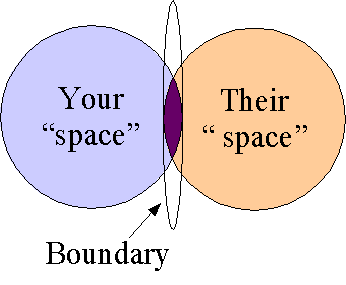
Hospice-Palliative Volunteer Ethics Boundaries (Research)


Does your hospice-palliative care organization have clear guidelines regarding boundaries for volunteers? If not, consider creating or modifying them to prevent future problems. Mount Allison University in Canada researched this ethics concern with two community-based hospice programs. When 79 hospice-palliative volunteers responded to a 27-item Boundary Issues Questionnaire, they indicated the boundary of each item. These are examples of one item in each of the three major categories:

Definite Boundary Issues
(things volunteers should never do).

1) Accept money from a patient or family.

Potential Boundary Issues
(things volunteers should stop and think twice about doing)

2) Accept a gift from a patient or family.

Questionable Boundary Issues
(things volunteers should be aware of doing)

3) Give your home phone number to a patient or family.

Would you agree with the three major labels? What are other items that volunteers might place under the three various categories? It would be interesting to know what volunteers perceive as their individual items of concerns and how they differ or agree on the boundaries relating to various items.

This research confirms the need for official boundary statements. This is information volunteers can benefit from through discussion and implementation with written policies. Keep in mind that having no clear boundary policies may lead to negative consequences later.

Frances Shani Parker, Author
Becoming Dead Right: A Hospice Volunteer in Urban Nursing Homes is available in paperback at many online and offline booksellers and in e-book form at Amazon and Barnes and Noble booksellers.

Friday, May 6, 2011

Fears of Lesbian, Gay, Bisexual, and Transgender (LGBT) Older Adults: Healthcare Staff Training and Housing (Research, Video 5:11)


Lesbian, gay, bisexual, and transgender (LGBT) older adults living in nursing homes, long-term care, assisted living, and even those receiving home care from healthcare workers have increasingly been discriminated against and abused by staff and fellow residents. Damage to their emotional and physical health has been so devastating that some LGBT residents have resorted to suicide.

In a study at Yeshiva University in New York, elderly participants in community and long-term care settings reported the following fears:
1) Fear of being rejected or neglected by healthcare providers, particularly personal care aides
2) Fear of not being accepted or respected by other residents
3) Fear of having to go back into the closet and pretend their sexual orientation is different

Important solutions to this problem include a national drive to train long-term care providers in equitable and compassionate care. University of Iowa findings from a nationally representative mail-in survey of over a thousand nursing home and social service directors revealed that three-fourths of the sample had not received even one hour of homophobia training over the past five years. Directors with the most experience reported having the least training. More development and dissemination of homophobia training is critically needed along with policy changes that positively impact the quality of life of LGBT older adults.
A move for separate, but equal housing is another solution that has been implemented to counteract the inequities many LGBT seniors experience. The nonprofit, 104-unit Gay and Lesbian Elder Housing (GLEH) Triangle Square in Los Angeles, California is the first affordable housing facility for lesbian and gay seniors. “A Place To Live - The GLEH Triangle Square Story,” a film by Carolyn Coal and Cynthia Childs, chronicles the journey of seven seniors attempting to secure a home there before it opened a few years ago.


Frances Shani Parker, Author
Becoming Dead Right: A Hospice Volunteer in Urban Nursing Homes is available in paperback at many booksellers and in e-book form at Amazon and Barnes and Noble booksellers.

Friday, April 22, 2011

Reluctant End-of-Life Caregivers: Would You Do It Again? (Research, Video 3:10)

Most people don’t set out to become caregivers. Some enjoy nurturing loved ones and find the caregiving experience challenging, but rewarding. Few people talk about caregivers who feel depressed, guilty, trapped in a hole with no way out except the death of persons in their care. Maybe they were the only sibling living near the parent, the only relative or friend with resources to provide care, or the only person willing to step up when others refused. Whatever their reasons, they became caregivers reluctantly, never fully embracing the responsibility, and made the most of the situation. If they had a choice, would they do it again? Some say they would not.

In a study reported in the “Journal of Pain and Symptom Management,” factors associated with an unwillingness to become caregivers again were reviewed. Former caregivers of palliative care patients were interviewed. Comparisons between those who would do caregiving again and those who would not were made with these results:

1)   One in 13 (7.4%) former caregivers indicated that they would not provide such care again.
2)   One in six (16.5%) would only "probably care again."
3)   Increasing age and lower levels of education controlling for spousal relationship lessen the willingness to care again.
4)   Despite most active caregivers being willing to provide care again, a
proportion would not.

This Visiting Nurse Service of New York video titled “How to Relieve Stress When Caring for an Aging Parent or Spouse” presents ways to cope with caregiver stress.


Frances Shani Parker, Author
Becoming Dead Right: A Hospice Volunteer in Urban Nursing Homes is available in paperback at many booksellers and in e-book form at Amazon and Barnes and Noble booksellers.

Friday, April 8, 2011

Quality of Life for the Oldest Old With or Without Dementia (Quiz, Research, Video 1:06)

How happy will you be when you’re 100 with or without dementia? Little research has been done regarding the quality of life of the oldest of the old, particularly those with dementia. With more people living longer, information concerning this age group is becoming more of a priority. Due to their interactions and observations of those aging in their care, caregivers can also add insightful information on this topic.
The following questions are worth considering regarding this geriatric population. See if you can guess the answers after you read the questions:

Do the oldest old perceive their quality of life as good or not so good?

Are their perceptions of quality different from or the same as the perceptions of their caregivers?

What if the oldest old have dementia? Do they perceive their quality of life as better or worse? Do their caregivers agree or disagree with the oldsters’ perceptions?

If you were guessing the answers as you read the questions, you may be surprised by the results of a Mayo Clinic investigation involving 144 community dwellers with mean ages ranging from 93 to 94.

Research Results:

Although the overall functional ability was higher in groups without dementia, all subjects reported high overall quality of life.

And the caregivers? Caregivers perceived the subjects' overall quality of life to be lower with increasing severity of dementia. The difference in subjects' and caregivers' perception is more pronounced for the groups with dementia. Apparently, quality of life is more strongly correlated with depression than with dementia severity.
The photo above showcases Mississippi Winn, a 113-year-old woman who was believed to have been the oldest living African-American in the country and the world's seventh-oldest person. She died January 14, 2011. This video features a reportedly 130-year-old Russian woman named Antisa who may have been the oldest woman in the world at one time.


Frances Shani Parker, Author
Becoming Dead Right: A Hospice Volunteer in Urban Nursing Homes is available in paperback at many booksellers and in e-book form at Amazon and Barnes and Noble booksellers.

Friday, December 10, 2010

The Long and Short of Hospice Time in Nursing Homes (Research)

As a hospice volunteer in Detroit nursing homes, I have had hospice patients stay as short as one day and as long as three years. With little quiet or privacy, almost all of them shared rooms with one to three non-hospice residents. My three-year patient was 94 years old. Having few visits from relatives and friends who lived out of town, her biggest fear was the possibility of being released from hospice care and the nursing home. I’ve also had rare happy patients who were released from hospice because their health improved.

One patient with dementia seemed to have a premonition that she would be leaving soon when she said to me one day, “I was wondering if you could help me find another apartment. I’ve been thinking about looking for a new place to stay, maybe a place closer to where I used to live. This apartment building is too noisy. Just close your eyes and listen to all the talking, buzzers, and everything. People come into my place without even knocking. They just walk right in and go through my closet and drawers. It’s not right. Three ladies even moved in with me when I wasn’t looking. Now, I can’t get them out.” I had never heard her say anything about leaving before. Two weeks later, she was released from hospice care and moved to a nursing home near her son’s house.

Are there characteristics of nursing homes and residents that are associated with long and short hospice stays? Using 13,479 residents enrolled in hospice care, researchers at Harvard Medical School looked for answers to this question. Research results indicated the following:
1)    Nursing home characteristics were not statistically significant predictors of long stays.

2)    The probability of a short stay increased with the facility's nurse staffing ratio and decreased with the share of residents covered by Medicaid.

3)    Men (relative to women) and blacks (relative to whites) were less likely to have a long stay and more likely to have a short stay.

4)    Those 70 years or younger (relative to those 81-90) and residents with Alzheimer's disease/dementia were more likely to have long stays and less likely to have short stays.

5)    Fourteen percent of hospice users were discharged before death because they failed to meet Medicare hospice eligibility criteria. These residents on average had longer lengths of stays.
If you work with hospice patients in nursing homes, have you noticed these occurrences? Researchers concluded “high rates of discharge before death that may reflect a less predictable life trajectory of nursing home residents suggests that further evaluation of the hospice benefit for nursing home residents may be needed.”
Frances Shani Parker, Author

Saturday, September 25, 2010

Successful Hospice-Nursing Home Partnerships (Research)


A hospice volunteer in Detroit nursing homes for many years, I am familiar with the benefits and problems that can occur when hospices and nursing homes operate as partners. These partnerships can work very well when certain best practices are followed. What do successful partnerships between hospices and nursing homes look like?

This study by Brown Medical School uses case studies of six nursing homes and hospices working collaboratively. Interviews were held with care providers and chief executive and financial officers regarding seven domains critical to successful collaboration. These were the results:

1) Nursing home-hospice collaborators were philosophically and otherwise aligned; they had similar missions, understood their differing approaches to care, and administrators demonstrated an openness and support for the collaboration.

2) Hospices developed infrastructures to correspond to the uniqueness and complexity of the nursing home environment. For example, they hired nurses with nursing home backgrounds, created teams dedicated to nursing home care, and trained hospice staff in problem solving and conflict resolution.

3) Care collaboration processes focused on the importance of two-way communication by actively soliciting and sharing information with nursing home staff and responding to nursing home staff and administrators' concerns.

This successful partnership model demonstrates how well collaboration can work when hospices and nursing home leaders commit to operating strategically using communication, flexibility, and skills to match staffing to the nursing home environment. 

Frances Shani Parker, Author

Saturday, August 7, 2010

Hospice-Palliative Care Doctors and Burnout (Research, Video 5:48)


Every profession has the potential for burnout, even when workers love what they do. With the growth in hospice-palliative medicine (HPM), more research is shining a light on how doctors in this field prevent burnout and promote self-care among themselves.

This research by the Mayo Clinic was reported in the Journal of Palliative Medicine. Participants included 40 HPM doctors practicing in America. These doctors were surveyed online about burnout prevention strategies and ways to find fulfillment in their professions. These were strategies used by 30 of 40 HPM physicians (19 males, 11 females) for burnout prevention:

1)    Physical well-being (60%)
2)    Professional relationships (57%)
3)    Transcendental perspectives (43%)
4)    Oral communication with others (43%)
5)    Hobbies (40%)
6)    Clinical variety (37%)
7)    Personal relationships (37%)
8)    Personal boundaries (37%)
9)    Time away from work (27%)
10)  Passion for one's work (20%)
11)  Realistic expectations (13%)
12)  Humor and laughter (13%)
13)  Memories of patients (10%)

HPM doctors use a variety of strategies to avoid burnout and maintain resilience. This research highlights the importance of dealing with burnout as it relates to doctors’ self-awareness and self-care. More research is needed to help physicians recognize burnout and individualized strategies for supporting themselves and their colleagues. This video titled “Palliative Curriculum - Part 15 - Cancer Doctors and Burnout” presents a scenario about burnout concerns.


Frances Shani Parker, Author
Becoming Dead Right: A Hospice Volunteer in Urban Nursing Homes is available in paperback at many online and offline booksellers and in e-book form at Amazon and Barnes and Noble online stores.

Saturday, July 3, 2010

Palliative Care or Supportive Care? Which Would You Prefer? (Research, Video 3:04)

Would a rose by any other name smell as sweet?

I have met quite a few people who don’t have a clue as to what palliative care is. Some are even in the healthcare profession. To add to the confusion, many who do know what it is refer to palliative care using various pronunciations (sound pronunciation). Then there are those healthcare organizations such as the American cancer centers that have adopted use of the name palliative care but continue to get referrals late for those needing it. Is this due to an association of the name palliative care with hospice care?  Would all these problems regarding the name palliative care be resolved by just replacing the name with a more user friendly one such as supportive care?

Obviously, the name palliative care carries several barriers that need to be explored. That’s why this research caught my interest. This study by the Anderson Cancer Center in Houston, Texas reports how the name palliative care versus the name supportive care may impact cancer patient referrals.

Can a name be a barrier to patient referrals for care? Medical oncologists and their midlevel providers (advance practice nurses and physician assistants) at a comprehensive cancer center think so. 140 out of 200 of them participated in a survey to determine the impact of the name palliative care compared with the name supportive care on patient referrals and to determine whether there was an association between demographic factors and the perceptions of the two names. What were the results?

1)    The name palliative care compared with the name supportive care was perceived more frequently by medical oncologists and midlevel providers as a barrier to referrals, decreasing hope, and causing distress in patients and families.

2)    Participants significantly preferred the name supportive care compared with palliative care. They also stated more likelihood to refer patients on active primary and advanced cancer treatments to a service named supportive care.

While these results are not surprising, where does this leave the name palliative care? Is this a matter of educating the public more to the meaning and appreciation of what palliative care can provide? Or is this a matter of phasing out usage of the term palliative care with patients and replacing it with the name supportive care? What do you think?

This video explains palliative care: “Palliative Care: What is it and who is it for?”


Frances Shani Parker, Author