Life is a journey. Death will come when it comes, no matter how often the topic is avoided, how forcefully technology wrestles it to the ground, or how sincerely pleas for more earthly time are requested. Consider using these ten steps featuring scenic routes on your journey to becoming dead right:
Frances Shani Parker, eldercare consultant and Detroit, Michigan author of Becoming Dead Right: A Hospice Volunteer in Urban Nursing Homes, writes this blog. Topics include eldercare, hospice, nursing homes, caregiving, dementia, death, bereavement, and older adults in general. News, practices, research, poems, stories, interviews, and videos are used often. In the top right column, you can search for various topics of interest to you. You can also subscribe to this blog or follow it by email.
Sunday, September 4, 2022
Becoming Dead Right in 10 Steps
Monday, August 1, 2022
Dementia Violence in Healthcare
As a hospice volunteer in Detroit, Michigan nursing homes, I viewed dementia as a fluttering bee. I never knew when it would make honey or sting. There were times when nursing home residents with dementia were rude or violent. I have seen a resident slap a nurse assistant (CNA) in the face with such force I thought she would fall over. To her credit, the CNA took a deep breath and walked away while another CNA interceded to work with the resident. The resident probably forgot the incident soon afterward. During violent situations involving residents living with dementia, caregivers have to protect themselves, restrain residents if they can, but resist expressing rage and fighting back.
Friday, July 1, 2022
Dying in Control (Research, Hospice Story)
People have complex attitudes about death, dying, and ethical considerations. A Massive Open Online Course (MOOC) titled “Dying2Learn” provided an opportunity for researchers to explore societal and personal attitudes about wishes and beliefs regarding death and dying. Among research results highlighted were desires of patients to exercise choice and control in relation to dying. Some individuals wanted control while preferring not to know that they were dying. Others wanted to know as much as possible and still be more in control. Even after legal matters related to death were in order, some patients had concerns that others might not consider important, but the element of control still mattered.
All this talk about control reminded me of my hospice patient named Rose. Are you ready to die? Rose was. This is what she said to me about her upcoming death that clearly indicated her need for control:
She began by asking me, “How old did you tell me I was?”
I responded, “You’re ninety-nine. You’ll be one hundred years old on your next birthday.”
“One hundred years old is too old. I don’t think I want to be that old.”
“There are three other ladies in this nursing home who are older than that. One is a hundred three. We talked to her last week during your wheelchair ride.”
“How much longer will it be before I make a hundred? I don’t know if I want to wait too much longer.”
“It’s only one more month. I remember you said you had spiritual talks with your minister. If you decide to wait, I’ll get you a big balloon that looks like a birthday cake.”
“I guess I could wait. Yes, I think I will wait. That way I can celebrate my hundredth birthday. When I do get to heaven, I can tell everybody I lived to be one hundred.”
And that’s exactly what she did because she felt she was in control.
(Excerpt from Becoming Dead Right: A Hospice Volunteer in Urban Nursing Homes)
Frances Shani Parker, Author
Becoming Dead Right: A Hospice Volunteer in Urban Nursing Homes is available in paperback and e-book editions in America and other countries at online and offline booksellers. Visit Hospice and Nursing Homes Blog and Frances Shani Parker's Website.
Wednesday, June 29, 2022
"Missing" - An Older Adult, Loneliness Poem
Many older adults rarely enjoy visitors they seldom see during most of the year. Whether at home or in institutions, loneliness can be both difficult and dangerous for their overall health. Too many of them endure the negative impact of loneliness daily.
“Missing” is one of sixteen original poems at the end of each chapter in Becoming Dead Right: A Hospice Volunteer in Urban Nursing Homes. A hospice volunteer, I wrote it after witnessing the sadness of lonely nursing home residents who were missing the missing. They coped with ongoing loneliness that could easily have been avoided with gifts of time. But some relatives and friends kept putting off visiting them until it was too late. Consider making every effort to visit those who are ill or alone. Don’t sentence them to another year of missing you.
Missing
She waited,
hoping her years of caring
endured in grown-up minds,
rested in distant hearts,
conveyed how much she missed them.
She waited,
living real-time movies
of restless nights, anxious days
with inhaled hopes of fellowship,
exhaled sighs of deep despair.
She waited,
wishing nostalgic winds
flowed through cotton curtains,
brought relatives and friends
she cherished through the years.
She waited,
grasping like a New Year's resolution,
like a second suspended in time
until her clock stopped ticking
for visitors who never came.
© Frances Shani Parker
Frances Shani Parker, Author
Becoming Dead Right: A Hospice Volunteer in Urban Nursing Homes is available in paperback and e-book editions in America and other countries at online and offline booksellers.
Hospice and Nursing Homes Blog, Frances Shani Parker's Website
Monday, May 2, 2022
Hospice Volunteer Meets Patient Living With Dementia
"That's Henrietta sitting by herself at the table," the nurse said to me. I followed her finger to a caramel-colored woman who sat humming. She had just finished eating and still hadn't wiped her mouth. A light coating of chicken grease looked like high-priced lip gloss when I walked closer to her.
Monday, April 4, 2022
Nursing Home Mealtimes With Dementia
At nursing home mealtimes, I served as a hospice volunteer at several Detroit, Michigan nursing homes for many years. Hospice residents are predicted to have up to six months to live, but may exceed that time. I had contact often with residents who were assigned or not assigned to me. My assigned hospice residents were always my primary concern. Most of them shared rooms with up to three people.
In the mealtime stories below, I shared a table with six other residents. Several were living with some form of dementia. Due to limited staff, I knew I would have to supervise, encourage, and generally keep an eye on everybody at the table. A Detroit, Michigan public school principal, I was used to multi-task management and didn’t mind assisting them weekly after school at all. These stories from my book Becoming Dead Right: A Hospice Volunteer in Urban Nursing Homes describe typical mealtime experiences with residents living with dementia:
Monday, March 7, 2022
Caregiver Abuse and Solutions December 2022
It is often said that everyone has a breaking point. What about caregivers working under very stressful conditions? What about caregivers who believe that, under no circumstances, would they ever commit an abusive act against people they have loved dearly their entire lives. Are they even aware that abuse or neglect of an elderly person can be a criminal offense, a basis for legal litigation, and not just a family problem?
The tremendous challenges of caregiving can be underestimated when the commitment is made willingly to accept the position. Cases of older adults being abused physically, psychologically, sexually, and financially by caregivers, some whom they loved and trusted, continue through the years. Yes, abuse takes place in institutions, but abuse also occurs in shared living spaces with caregivers who are loved ones and relatives.
Caregivers must always be consciously aware of their own needs and limitations as they go about the business of taking care of vulnerable people who depend on them. Respite time away from their patients can play a significant role in keeping them balanced, revitalized, healthy and relieved from excessive stress. This is time when they can reflect on and fulfill their own needs in ways they enjoy, socialize with others, explore resources and people who can support them on their caregiving journey.
You may report suspected elder or vulnerable adult abuse, neglect, or exploitation to Adult Protective Services by calling 855-444-3911. To report abuse in a nursing facility, call the Attorney General's Health Care Fraud Division on their statewide hotline, 800-24-ABUSE (800-242-2873).
Notify the Michigan Department of Health & Human Services (MDHHS) Adult Protective Services at 855-444-3911, if you suspect elder or vulnerable adult abuse, neglect, or exploitation.
The National Center on Eldercare Abuse (https://ncea.acl.gov/) or NCEA provides the latest information regarding research, training, best practices, news and resources on elder abuse, neglect, and exploitation to professionals and the public. The NCEA is a resource for information on abuse, neglect, and exploitation of older people. All of these organizations can assist people in getting help.
Frances Shani Parker, Author
Becoming Dead Right: A Hospice Volunteer in Urban Nursing Homes is available in paperback and e-book editions in America and other countries at online and offline booksellers. Visit Hospice and Nursing Homes Blog and Frances Shani Parker's Website.
Monday, February 7, 2022
Dementia, Hospice, Ancestor Poem
Recently, I thought about Miss Loretta when I discovered a website with photos featuring elderly hands. Immediately grabbing my attention were mesmerizing hands very similar to Miss Loretta's. I felt her presence reassuring me again in her own unique way through scattered recollections of historical backstories. I recalled a poem I had written years ago that was inspired by our special kinship. Miss Loretta's spirit continues to influence my life as I create my own wrinkled legacy.
The following poem is my special tribute to Miss Loretta and our awe-inspiring ancestors who endured the unendurable while creating pathways for future generations. Their helping hands and unwavering resilience gifted us with treasured testimonies about joy, pain, courage and survival beyond dementia and far deeper than words.
"Deeper Than Words" by Frances Shani Parker
The outside world arrives wearing my willing face.
Toothless, your smile widens like a baby's hungry for attention.
Almost ninety-eight years old, your inner candle still glows.
A hospice volunteer, I lean closer, talk into your listening left ear.
"Today is Sunday, Miss Loretta." My news drifts away like smoke.
You stare at me through dying coals. Whatever I ask, you whisper, "Yes."
I stroke your age-softened hands while your hazed mind masters sleep.
Watching you, I dream generations of women black and strong,
each one a book of sustaining stories about joy, pain, courage, survival.
Within your warm, brown frame, spirits from our common history linger.
Aides say you have dementia, that you don't know a word I say.
Our language goes deeper than words. We speak to each other's souls.
Frances Shani Parker is author of Becoming Dead Right: A Hospice Volunteer in Urban Nursing Homes available in paperback and e-book editions in America and other countries at online and off-line booksellers. Visit Hospice and Nursing Homes Blog and Frances Shani Parker's Website.
Monday, January 3, 2022
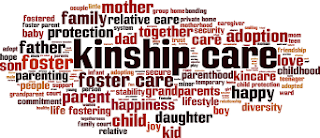
Kinship Care: What is it?
"Kinship care" is a popular term often used in reference to caregiving performed by a family member. I believe non-relatives who serve as committed caregivers during illness should also be included in the kinship care definition and treated as such. This story from my personal experience is one example of many that explains why.
Back in the 70's, the HIV-AIDS virus evolved into an epidemic/pandemic in LGBTQ communities. AIDS (Acquired Immune Deficiency Syndrome) is a disease with severe loss of cellular immunity and resistance to infections. I was a busy, Detroit, school principal who started helping Jake, a gay man I barely knew. He would come around my school sometimes at the end of the day to talk briefly with me while watching students leave.
In his thirties, Jake confided that he suffered daily harassment from invisible people. His conversations were often bizarre and heartbreaking. One day, he mentioned his real-life boyfriend had left him. I phoned his family to get him more support. Unfortunately, they had given up on him and advised me to do the same. His mother deeply resented his homosexuality and gay lifestyle.
Based on his appearance and actions, I suspected Jake had AIDS. I drove him and the "invisibles" to the hospital. He was admitted immediately and later placed with other AIDS patients in an isolated section of a nursing home. A young woman phoned me one day explaining that Jake was her biological father who had not raised her. She said she wanted to see him before he died and that she was busy taking care of her husband, her children, and being a waitress.
The invisible people finally left Jake. Time passed during his death journey that included ongoing high fevers, chills, sores, weight loss, regular coughing, and breathing problems. This was my first major introduction to hospice care. I wasn't Jake's relative, a close friend of his family, or even a member of the LGBTQ community I supported. But I knew I was kinship.
* * * * * *
I wrote the following poem about Jake that was read at the 13th International AIDS Conference held in South Africa. Jake was there in spirit enjoying all the loving expressions he missed in life.
Remembering Jake
A lonely leper with AIDS,
you existed in a colony of inhumanity,
seldom felt life's caring caresses.
While demons dragged your body
through gutters of deterioration,
you relinquished your confused mind
to unseen terrorists who stalked,
robbed you of much needed rest.
I watched your painful decay,
witnessed abuses by family and friends
treating you like toxic waste.
Rare handfuls of love brought
limited smiles in your leper's life.
Sweet death delivered your only peace.
Frances Shani Parker
Frances Shani Parker is author of Becoming Dead Right: A Hospice Volunteer in Urban Nursing Homes available in paperback and e-book editions in America and other countries at online and off-line booksellers. Visit Hospice and Nursing Homes Blog and Frances Shani Parker's Website.
Sunday, December 12, 2021
Empathy in Healthcare
The ability to empathize is especially important in healthcare professions where biases can contribute to healthcare disparities. Sometimes the bias is overt, even intentional. Other times, it is done implicitly, unconsciously, but still doing harm. Healthcare providers must be able to better recognize situations where they can offer empathy in addition to problem solving. Patient care is more than just physical healing. Good healthcare includes building a connection that encompasses a patient’s mind, body, and soul. It includes standing in someone else’s shoes, feeling what that person feels, and responding in the appropriate manner.
One way of learning empathy in general living is by consciously putting yourselves in the position of others in an effort to better understand what they experience. Older adults are a growing population that more people are having contact with as caregivers and in general living. By simulating the experiences of many older adults, everyone and especially young people can develop deeper understanding of various issues of old age that they may not have considered. This helps them develop more empathy for the older adult population and a better understanding of how they can navigate their own aging.
Sunday, November 7, 2021
Sexuality, Healthcare, and Older Adults (Video 3:24)
Saturday, October 2, 2021
School-Nursing Home Partnerships (Service-Learning, Dementia)
A growing body of service-learning research shows that students benefit academically and affectively from service-learning. Because teachers prepare students well before their nursing home visits, students know what to expect. If a resident falls asleep or cries, students understand why that is okay. Dementia is understood with relevance and meaning. Students are open to the experience of being with the elderly and the challenged. They take pride in the roles they play as visiting caregivers who enrich lives. They empathize with the realities of residents living with dementia.
After students return to school, they reflect on how their nursing home visit affected residents and themselves, what they learned, and ways to share that information with others. While students' reflections can take many forms (written, oral, dance, music, art), the poem below is an example of a student’s poetic reflection. My book, Becoming Dead Right: A Hospice Volunteer in Urban Nursing Homes, includes a chapter on intergenerational partnerships between schools and nursing homes.
A Student's Service-Learning ReflectionsI know you erase yourroommate sometimes,take distant trips in your mind,
see me as a short brown blurwhen I visit your nursing home.I know your childhoodfriends whisper secrets,your favorite dress has ruffles,my cards touch you with sunshine,you love the stories I tell.I know that carrotsmake you frown,my visits swing you higher,loneliness glues you down,you miss your friends who died.I know your words
make me feel better,feed my heart with praise,help me care about othersthe way you care about me.© Frances Shani Parker
Note: Winner of the National Service-Learning Partnership Trailblazer Award, Frances Shani Parker, a hospice volunteer, writer, eldercare consultant, and retired Detroit Public Schools principal, has been instrumental in implementing service-learning in school districts across America.
You can read about fourth graders' nursing home research on ageism stereotypes here.
Frances Shani Parker, Author
Becoming Dead Right: A Hospice Volunteer in Urban Nursing Homes is available in paperback and e-book editions in America and other countries at online and offline booksellers. Visit Hospice and Nursing Homes Blog and Frances Shani Parker's Website.

Wednesday, September 1, 2021
Are You Asking People to Tell You Your Name?
Seriously, if you do this, please stop asking people living with dementia to tell you your name when you greet them. Don't start the conversation with a test they might fail along with your hurt feelings when they do fail. Just say your name and who you are. If they decide to give you another name, that may be okay, too. Don't say that person has been dead ten years, and you told them that 925 times. Don't say that dead people are never coming to visit them again, so quit asking about them or you will take them to the cemetery to see their graves as proof.
Can we all just get along and lighten up? As a hospice volunteer over 20 years mostly in Detroit nursing homes, I have learned there is no one way of handling dementia issues. A lot depends on the level of the disease a person has and their reality. Personally, I have enjoyed impersonating other people sometimes. For example, I have pretended to be a male hospice patient's deceased wife. When I entered his room the first time, he grinned widely, called me Judy, and said how glad he was to see me. Instinctively, I decided to try being Judy, even though I knew from the brief information I had been given about him that Judy, his deceased wife, had been dead several years.
From that day until he died, I entered his reality world as Judy whenever he decided that was who I was. Although neither one of us sang too well, we loved crooning old Motown songs when we reminisced about our dates at Belle Isle Park when we were married. Passing ships, seasonal surroundings, and our general joy were back-in-the-day scenarios we revisited. I often let him take the lead with his descriptive memories that were enlightening, amusing, and welcoming to me. I felt like I was right where I belonged being Judy. I knew we were making progress on some level.
When each visit ended, we BOTH had created more wonderful memories of our special time together at the nursing home. We could recall later with pleasure our experiences featuring a union of minds that made perfect sense to us. And I knew that I could always go back to being Frances Shani Parker in my own reality world any time.
Frances Shani Parker, an eldercare consultant and retired school principal, is author of Becoming Dead Right: A Hospice Volunteer in Urban Nursing Homes. This book is available in paperback and e-book editions in America and other countries at online and offline booksellers. Visit Frances Shani Parker's website.
Monday, August 2, 2021
Life After Death Dementia Story
When Mamie Wilson (pseudonym) became my hospice patient, she had several unusual qualities that made me wonder. At sixty-five, she was the youngest person assigned to me after years of volunteering at various Detroit nursing homes. She had the same name as my grandmother, and I had her grandmother's name. When we made these discoveries during our first meeting, we took them as signs that we were destined to have a great patient - volunteer relationship. In time, however, I learned that the most unusual thing about Mamie was what she said.
“Is your mother alive?” Mamie asked me one day.
“No, she died a few years ago in her eighties,” I responded.
“You know, you can still be with her and talk to her if you want to.”
“Oh, I know we can still communicate.”
“No, I mean for real. You can be with her in person. Just get her clothes together and her shoes. Don’t forget her coat. They say it’s cold outside. Take them to the cemetery where she’s buried. Just set them on top of her grave and wait. She’ll rise out of her grave and put them on. Then you can take her home with you. In every way, she’ll be the same person you knew. Other people won’t be able to see her, but you will.”
“Hmm. I’ve never heard that before.”
Mamie responded, “Most people haven’t. I know about it because I did it with my two grown sons. They were both murdered on the same day in a drive-by shooting. I didn’t know how I would get through the pain. Finally, I took their clothes to the cemetery and did what I just told you. Both of them came home with me. It was the best day of my life. I got my sons back.” Satisfied, she smiled.
Some people will dismiss this story as crazed comments of a demented woman. But if you really listen, you’ll hear the magnificent empowerment in her words.
Frances Shani Parker, Author
Becoming Dead Right: A Hospice Volunteer in Urban Nursing Homes
This book is available in paperback and e-book editions in America and other countries at online and offline booksellers. Visit Frances Shani Parker's Website